Introduction
Infrastructure as Code (IaC) manages infrastructure through code instead of manual configuration. Instead of clicking through consoles to set up servers, networks, and storage, you define your infrastructure in code and let a tool provision it for you.
What IaC means in practice
IaC lets you define and manage every aspect of your infrastructure using code, giving you more control and fewer error-prone manual steps than clicking through a console.
Benefits of IaC
Reproducibility
With IaC, you can reproduce your infrastructure exactly. The code acts as a blueprint: running it again creates an identical environment. This consistency makes deployments predictable and troubleshooting easier.
Scalability
Scaling your infrastructure becomes as simple as modifying a few lines of code. IaC lets you adjust the capacity of your resources to meet the demands of your applications, whether that means adding more servers or expanding storage.
Time savings
IaC automates the provisioning and management of your infrastructure, cutting down the time spent on manual configuration. That leaves more time for improving your systems instead of repeating routine tasks.
Implementing IaC
Declarative vs. imperative
You can write IaC declaratively or imperatively. With the declarative approach you state the desired end state of the infrastructure, and the tool works out which actions get there. With the imperative approach you spell out the steps yourself and walk the system through the changes.
Popular IaC tools
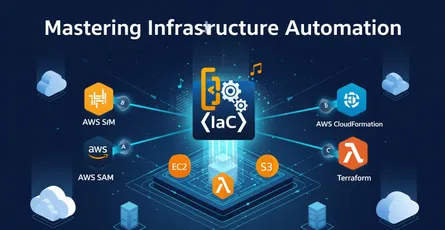
Several IaC tools are available, each with its own strengths. Tools such as AWS CloudFormation, Terraform, and Ansible provide ways to define and manage infrastructure using code, with broad resource support and integrations with popular cloud providers.
Additional advantages of IaC
Collaboration and version control
With IaC, infrastructure configurations can be stored in version control systems, so multiple contributors can work on them together. Changes can be tracked, reviewed, and rolled back if needed, which keeps the workflow auditable.
Infrastructure testing and validation
IaC enables automated testing of infrastructure configurations before deployment. Validating the code through testing pipelines helps you catch issues early instead of after they reach production.
Disaster recovery and high availability
IaC makes disaster recovery and high availability strategies more attainable. Because the desired state of your infrastructure is codified, you can recreate and recover your environment after a failure. IaC also makes it easier to implement redundancy and fault-tolerant architectures.
Adopting IaC
IaC adoption keeps growing because it simplifies operations, reduces human error, and lets teams move faster. Adopting it requires a shift in mindset and ongoing learning, but it pays off in more scalable, efficient infrastructure.
Conclusion
Infrastructure as Code changes how teams manage infrastructure. Treating infrastructure as code lets you automate, scale, and reproduce environments reliably, which frees up time for other work. The tools covered here, CloudFormation, Terraform, and Ansible, are a good place to start.
References
- What is Infrastructure as Code? - AWS, https://aws.amazon.com/devops/infrastructure-as-code/
- Terraform by HashiCorp - Official Website, https://www.terraform.io/
- AWS CloudFormation User Guide, https://docs.aws.amazon.com/AWSCloudFormation/latest/UserGuide/Welcome.html
- Ansible Documentation, https://docs.ansible.com/
- Declarative vs. Imperative IaC - Microsoft Learn, https://learn.microsoft.com/en-us/devops/deliver/what-is-infrastructure-as-code#declarative-vs-imperative
- The Twelve-Factor App - (Principles relevant to IaC and modern app development.), https://12factor.net/
- Git - Version Control System, https://git-scm.com/
- Continuous Integration (CI) and Continuous Delivery (CD) - Atlassian, https://www.atlassian.com/continuous-delivery/principles/continuous-integration-vs-delivery-vs-deployment
- Martin Fowler - InfrastructureAsCode, https://martinfowler.com/bliki/InfrastructureAsCode.html
- “What is Infrastructure as Code? An Introduction” - Red Hat, https://www.redhat.com/en/topics/automation/what-is-infrastructure-as-code-iac
- “Benefits of Infrastructure as Code” - HashiCorp, https://www.hashicorp.com/resources/what-is-infrastructure-as-code